


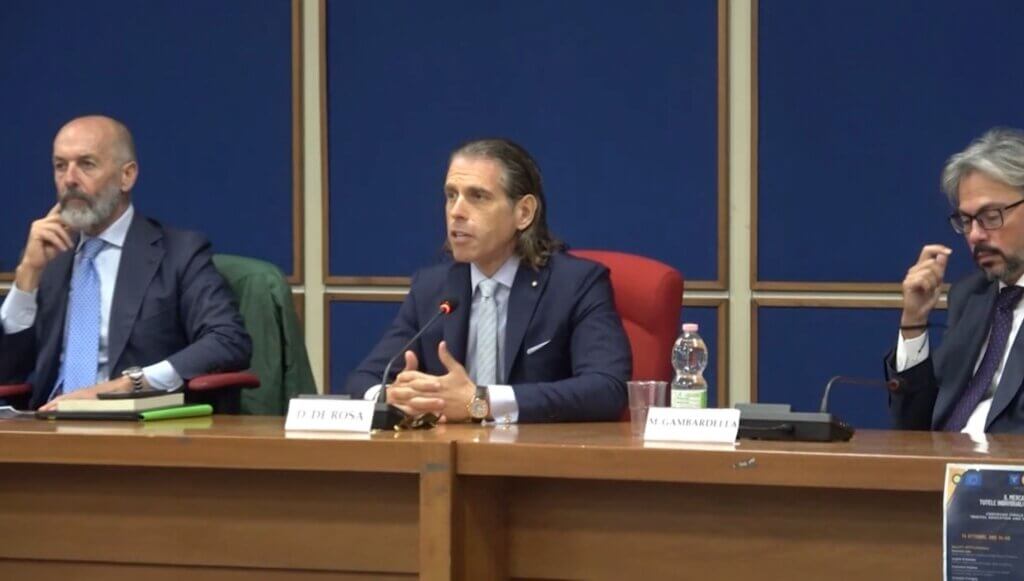
Cavaliere Domenico De Rosa attended a conference at the University of Salerno that brought together academics, professionals, and institutional representatives to discuss the relationship between education and the business world. On that occasion, he strongly emphasized how essential it is to rebuild the dialogue between universities and businesses—two worlds that all too often run on parallel tracks. The university must once again become a crucible of thought and expertise, but also a place capable of engaging with economic and industrial realities. Businesses, for their part, face the test of the market every day and bring with them a concrete understanding of the country’s problems. When education and business come together, a virtuous ecosystem emerges that generates employment, innovation, and trust.
In his remarks, De Rosa also addressed the issue of European regulations, highlighting the risk of excessive bureaucracy that ultimately hinders growth. “Europe,” he said, “must rediscover a sense of proportion.” In recent years, a regulatory system has been built that often ignores industrial reality and the daily difficulties faced by manufacturers. Overregulation stifles competitiveness, discourages investment, and drives young people away from productive work. We need simple rules, concrete objectives, and the ability to distinguish sustainability from ideology. The environment is not protected by bans, but by technology, industry, and research.
Speaking to young people, De Rosa emphasized the importance of passion and a healthy relationship with technology. He reminded them that technology is not an end in itself, but a means to an end, and that it is up to humans to guide it, not be controlled by it. Artificial intelligence and automation should not be feared, but rather understood and used to free people from the most tedious tasks, allowing them to take on more skilled and creative roles. “Passion,” he said, “is the true renewable energy—the kind no machine will ever be able to replace.”
Speaking of logistics, a sector in which his group is a European leader, De Rosa explained how this field serves as a natural school of efficiency, organization, and responsibility. Logistics teaches that everything is interconnected, that every decision has a precise timing and a direct impact. It is a model of practicality that should also be applied to politics, administration, and education, because it would make the country faster, more effective, and more competitive.
In a time of uncertainty, De Rosa chose to conclude with a message of confidence: “Italy still possesses an extraordinary strength made up of intelligence, creativity, and talent. We must stop chasing distant models and return to believing in our own capabilities. We need courage, vision, and a new alliance between those who study and those who produce. Only in this way can the country return to creating real value, restoring dignity and a future to work and knowledge.”